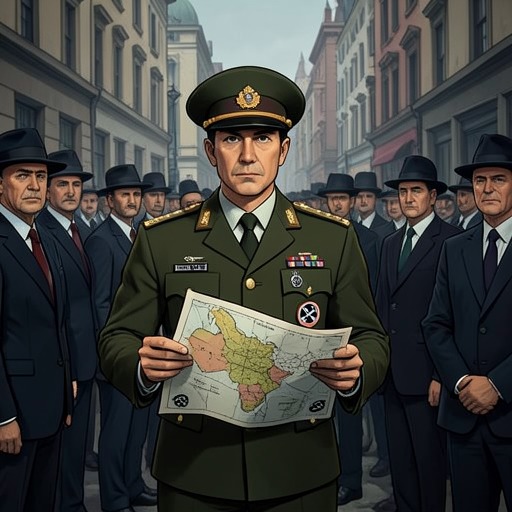
Perón’s Third Position Project
The Disappearance of Josef MengelePerón’s Third Position Project was Juan Perón’s attempt to cast Argentina as an alternative to both capitalism and communism and, after the defeat of Fascist Italy and Nazi Germany, as a power able to inherit their place in world history. Its language promised a national, social, and Christian settlement of political contradictions; its practical reach included opening Argentina to European specialists and war criminals. The project thus connected a sweeping political vision to the movement of people, institutions, and escape routes across national borders.
Ideological Design
Juan Perón’s political outlook took shape through observation as well as doctrine. In 1939 he travelled through Italy after studying Benito Mussolini’s theories of Fascism and war, serving as a military attaché at the Argentine embassy in Rome. He spent two years travelling, studying, and taking notes. He regarded the political changes he observed as part of an extraordinary historical experience: the creation of a populist democracy. His admiration extended to the disciplined organization of the state under Fascism and, during a separate visit to Germany, to the apparent efficiency of a country reorganized under Nazism.
Perón framed these influences through a theory of human contradiction. In his account, people were neither purely rational nor wholly governed by brute impulse; they were divided beings caught between competing desires. He treated history as the continuing struggle among those contradictions. Capitalism, in this analysis, exploited the individual, while communism subordinated him. Perónism claimed to move beyond both systems by reconciling individual and collective life, and by joining bodily needs to spiritual aspiration. Its promised destination was a national, social, and Christian Argentina.
This language gave the project a transnational frame even as it placed the nation at its centre. Perón interpreted the Second World War as a contest in which Fascist Italy and Nazi Germany had offered an alternative to the established powers of capitalism and communism. He described the United States and the Soviet Union as united against the emergence of this third force. After the Axis defeat, he did not abandon that framework: he imagined that the rival victors would eventually destroy one another and that Argentina could take the defeated European powers’ place.
From Worldview to State Project
Perón’s postwar ambition was not limited to an abstract claim of ideological independence. He anticipated a future in which Argentina could become a superpower, and treated the remnants of defeated European regimes as resources for that ascent. The country welcomed large numbers of Nazis, Fascists, and collaborators, including soldiers, engineers, scientists, technicians, and doctors. They were invited to contribute to projects such as dams, missiles, and nuclear power plants. The logic was instrumental: people associated with defeated regimes could be incorporated into a new national project if their expertise served Argentina’s power.
That recruitment sat alongside an increasingly authoritarian domestic order. Perónist rule purged universities, the press, and legal and administrative institutions, while expanding the secret service. The contrast matters to the project’s claims of reconciliation: its promise to transcend established political systems accompanied the tightening of control at home. The Third Position offered a popular national creed, but the state enforcing it narrowed the space for dissent.
Escape Networks and Political Fraternity
The state’s welcome to European fugitives acquired a logistical form. Perón personally oversaw the escape operation and established an Information Office in Buenos Aires. A former Schutzstaffel (SS) captain was sent through Spain, Switzerland, and Italy, while intermediaries coordinated routes through diplomats, corrupt officials, intelligence operatives, and clergy. These ratlines helped fugitives leave Europe and offered them protection from the consequences of their wartime crimes. The network’s transnational character was central to its operation: escape depended on chains of assistance crossing borders and institutions, not on a single act of admission into Argentina.
A speech by Pierre Daye shows how supporters joined this practical arrangement to ideological language. Addressing an audience of European extremists, Daye cast the conflict between Cain and Abel as an enduring struggle within human society and identified materialism and atheism as common enemies. He praised Perón for making the fraternization of their cause his mission, and presented Argentina as a counterweight to the United States. The appeal to Christian reconciliation gave former Nazis, Fascists, and Ustaše a shared political vocabulary, while Daye’s promise that they would return to Europe linked their refuge in South America to continued ambitions abroad.
Extradition and the Afterlife of the Project
The consequences are visible in the pursuit of Josef Mengele. After the International Auschwitz Committee helped gather evidence, an arrest warrant was issued in Freiburg im Breisgau on 25 February 1959, charging him with multiple cases of premeditated murder and attempted murder. The case crossed jurisdictions: German authorities had to seek extradition from Argentina, while reports that Mengele had fled to Paraguay brought that country into the process. When the extradition requests moved through Argentine ministries, courts, police, and diplomatic offices, delay and procedural obstacles weakened the effort. In November 1959, Paraguay granted Mengele citizenship, a residence permit, a certificate of good behaviour, and an identity card, despite the five-year residence requirement for naturalization.
The later pursuit revealed how the political relationships built around fugitives could frustrate formal requests. In 1962 West Germany sought Mengele’s extradition from Paraguay; President Alfredo Stroessner refused to cooperate. The following year, a promised aid payment of ten million US dollars did not change that position. In 1964, as the Frankfurt Auschwitz trials drew international attention, West German officials publicly identified Mengele as a Paraguayan citizen believed to travel in the tri-border region and Brazil. Stroessner rejected pressure to strip him of citizenship, invoking Paraguayan sovereignty. The same year, Fritz Bauer announced a reward for Mengele’s capture, but the Paraguayan interior minister denied that he was in the country.
This record does not make every later obstruction a direct consequence of Perón’s personal intervention. It does show the durable importance of the postwar refuge system associated with his project: citizenship, diplomatic resistance, loyal intermediaries, and cross-border concealment could turn jurisdictional boundaries into obstacles to prosecution. The Third Position’s claim to offer a sovereign alternative to the dominant powers therefore had a concrete and troubling underside. Argentina’s bid to gather people and expertise for national advancement helped establish networks through which fugitives could evade justice well beyond the moment of their arrival.